A man who allegedly wore a Chucky mask as he stalked a female jogger in Philadelphia and asked her whether she was ‘ready to die’ may be hiding out on the West Coast.
Zymire Hughes, 22, has apparently fled the City of Brotherly Love amid an arrest warrant charging him with making terroristic threats, harassment, simple assault, reckless endangerment and witness intimidation.
He may have since traveled to California or Nevada, police said.
‘We’ve received information he has a tendency to travel back and forth to the West Coast, California, the LA area and also Las Vegas for employment reasons,’ Philadelphia Police Captain Jason Smith said in an update on Thursday.
His exact whereabouts in the region remain unclear as authorities work to determine how he may have traveled to the West Coast.
In the meantime, law enforcement agencies across Southern California and Nevada are monitoring the transportation hubs and following up on possible sightings, FOX LA reports.
Hughes was caught on camera running behind a woman as she crossed through an intersection on August 12.
As he then approached the jogger, he held up his cell phone and asked her ‘Are you ready to die?’ Captain Smith said.

Zymire Hughes, 22, seen in a previous mug shot, stands accused of chasing a 40-year-old female jogger during her early morning run at around 5.30am on August 12
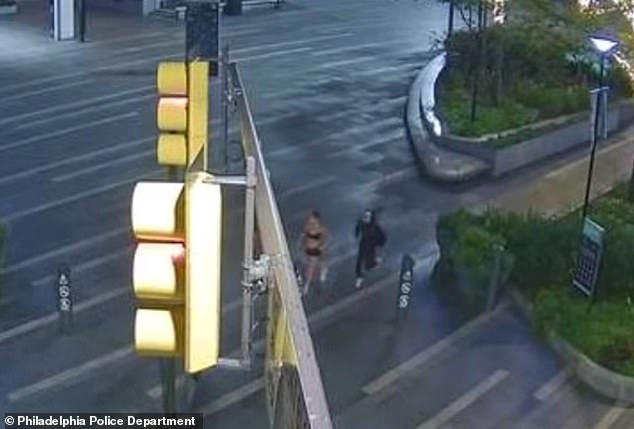
The lone jogger was chased by a man wearing a Chucky doll mask, who allegedly terrorized multiple people, laughed at his victims and asked if they were ‘ready to die,’ police said
Manhunt for predator in ‘Chucky mask’ seen chasing female jogger
It took place over approximately 15 to 16 minute time
‘She appears startled, at which time the male asks her again “Are you ready to die?”‘
At that point, the woman tried to flee while screaming for help – sustaining a leg injury during her escape.
The victim was seen on video having turned around in an apparent attempt to lose the masked figure, but he quickly changed course to continue his pursuit.
A second camera showed the jogger running down a five-lane road with the suspect trailing behind her.
He was seemingly unable to catch up with her and changed his route while the woman was just feet ahead.
He crossed multiple lanes of traffic and diverted to the sidewalk on the right-hand side of the street as the runner continued to jog down the road.
The suspect had allegedly terrorized multiple people in the community, with police claiming he laughed at his victims and asked if they are ‘ready to die.’
‘If Zymire Hughes was trying to scare people, make them run. Who’s scared now? Who’s running now?’ Philadelphia District Attorney Larry Krasner said.
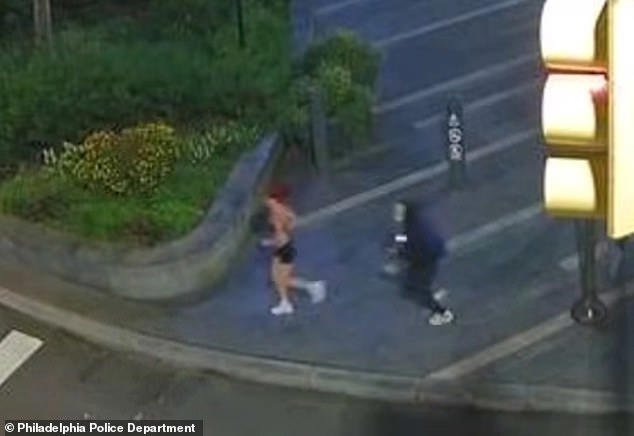
Cameras caught the suspect chasing the 40-year-old near City Hall around 5.30am

Investigators released several photos of the suspect, which show him sporting the Chucky mask and a blue plaid backpack
‘You think it’s funny to scare people? Well, get ready to get scared by us because we got the handcuffs. We got the jail cell. We got the Philly jury that’s going to tell you it’s not funny at all.
‘You think it’s funny to make people run, get your sneaks? Because that’s what Zymire Hughes is doing right now.’
Krasner noted that Hughes is on probation for an unspecified crime in Montgomery County.
‘There is nobody in the world who should be trying to imitate what this scared man who’s running is doing,’ the DA added.
‘Now he’s a punk. I mean, that’s the bottom line. He’s a punk who scared a lot of people for no good reason, and we’re not going to tolerate it.’
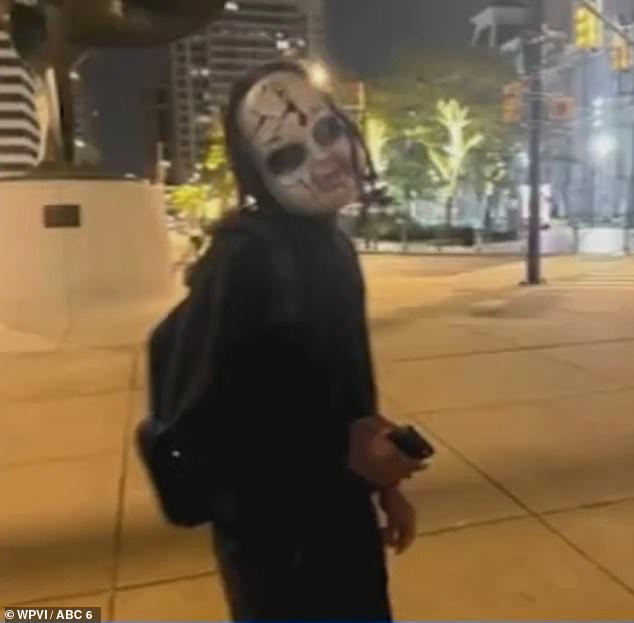
The suspect, seen with a phone in his hand, allegedly terrorized multiple people in the community
A second victim claimed that the suspect appeared to be filming the nightmarish encounters on his cell phone.
Jameka, who declined to share her last name, told WPVI that a man approached her with his phone in hand just moments after he had chased another woman.
‘I started to wave at her from across the intersection and say, “Hey, there’s someone behind you – look behind you!” And she heard me, and then she started to run away,’ she claimed.

Become a DC Insider!Daily Mail’s politics newsletter, delivered to your inboxSign up now
She said the suspect then tried to force his way into a local coffee shop, but after being denied entry, turned his attention towards her.
The alleged victim screamed ‘don’t follow me’ and put up her hands in a fighting stance, she recalled.
‘I blocked my face, making sure my centerline was protected. And then he also started to put his hands up but I could tell that he’d never been in a fight before,’ she told the news outlet.
Jameka, who described the suspect as appearing ‘disoriented,’ claims he ran away after she kicked him.
Anyone in the Los Angeles area who now spots Hughes is now urged to contact police immediately, while anyone else in Philadelphia who may have been terrorized by him is encouraged to reach out to the Central Detective Division.